
Why Do Lighter Meals Still Feel Heavy Sometimes? — And What’s Behind That Sluggish Feeling
 By Dr. Wali
You had a modest lunch. A sandwich, perhaps a small salad — nothing rich, nothing oversized.
An hour later, you feel weighed down. Full. A little sluggish, as though you had eaten far more than you actually did.
That mismatch — a light meal that still leaves you feeling heavy — is one of the most familiar digestive complaints described by UK adults. And it can be genuinely puzzling, because the usual advice is simply to eat less. When the meal was already small, that advice doesn’t fit.
This article explains why a light meal can still feel heavy, what is happening inside your digestive system when it does, and what you can realistically do about it.
What actually causes that heavy feeling after eating?
A heavy feeling after eating is rarely about how much food was on the plate.
It is about how quickly, and how completely, that food is being processed.
When you eat, food does not pass straight through. It collects in the stomach, where it is mixed with acid and digestive enzymes and broken down into a semi-liquid state before being released, in controlled amounts, into the small intestine. That release is called gastric emptying. While food is still sitting in the stomach waiting its turn, the stomach is fuller — and a fuller stomach for longer is, in plain terms, the sensation most people call heaviness.
So two meals of identical size can feel completely different. A light meal that is demanding to break down, or eaten in a way that slows digestion, can sit in the stomach longer than a larger meal that the body processes briskly. The heavy feeling is a pacing problem, not a portion problem.
This is also why post-meal heaviness often overlaps with mild indigestion and with the early stages of bloating. They are different sensations, but they frequently share the same root: food moving through the system more slowly than it should.
Summary: A heavy feeling after eating usually reflects how slowly the stomach is processing and emptying a meal — not simply how large the meal was. Even a light meal can feel heavy if it is demanding to break down or eaten in a way that slows digestion.
Why does digestion slow down — even when the meal is light?
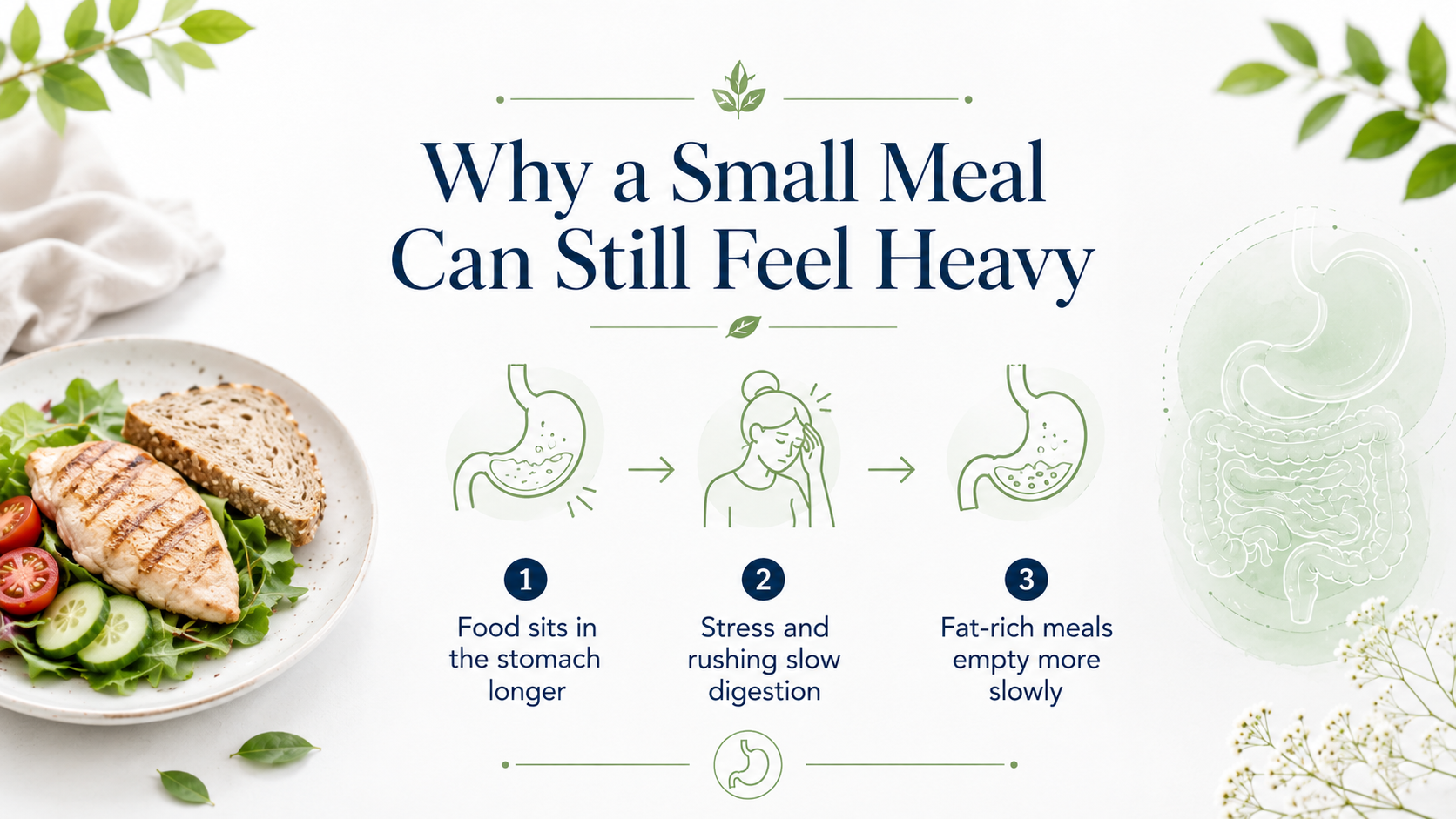
Digestion is a sequence, and each stage depends on the one before it.
It begins in the mouth, where chewing breaks food down physically and signals the stomach to prepare. In the stomach, acid and the enzyme pepsin begin breaking down protein while muscular churning turns the meal into a smooth mixture. That mixture then moves into the small intestine, where pancreatic enzymes — proteases for protein, lipase for fat, amylase for carbohydrate — continue the work, and where most nutrient absorption takes place.
If any stage runs slowly, everything downstream waits.
Two factors matter most for the feeling of heaviness specifically. The first is gastric emptying rate — how quickly the stomach hands food on. Fat is the slowest macronutrient to leave the stomach, which is why a small but rich meal can feel heavier than a larger, leaner one. The second is the state of your nervous system. Digestion is governed by the parasympathetic, or “rest and digest”, branch of the autonomic nervous system. When you eat in a hurry, under stress, or while distracted, the body stays tilted toward its “alert” mode and gives digestion lower priority. The meal is processed less efficiently, and it lingers.
Underneath both of these sits the question of digestive capacity — whether your stomach acid and enzyme output are keeping pace with what you eat. When they are modest, even an unremarkable meal can take longer to clear.
Summary: Digestion is a sequence, and a heavy feeling sets in when the stomach empties slowly. Fat content, eating under stress, and the body’s overall digestive capacity all influence how long a meal sits before it moves on.
The factors most likely to make a meal feel heavy
Some habits and food choices make heaviness far more likely — often more so than the size of the meal itself.
Eating too quickly. Digestion begins in the mouth. Eating fast skips that early stage, delivers larger food particles to the stomach, and gives the brain less time to register fullness. The result is a stomach working harder, for longer.
A high fat load. Fat is digested slowly by design. A small meal built around cheese, fried food, creamy sauces, or pastry can sit in the stomach noticeably longer than a larger meal that is leaner.
Eating under stress or on the move. A meal eaten at a desk, in the car, or between tasks is digested in the body’s “alert” state rather than its “rest and digest” state. Digestion becomes less efficient from the very first bite.
Eating late in the evening. Digestion naturally slows as the day winds down. A meal eaten shortly before bed tends to clear more slowly than the same meal eaten at midday.
Lying down or slouching afterwards. Sitting upright lets gravity assist the natural downward movement of food. Reclining straight after eating works against it.
Fizzy drinks with meals. Carbonated drinks introduce gas directly into the stomach, adding a feeling of pressure and fullness on top of the meal itself.
Poor sleep the night before. Tiredness affects digestive rhythm and appetite signalling, so a meal eaten after a broken night can feel heavier than usual.
Summary: Eating quickly, a high fat load, eating under stress or late at night, reclining after meals, fizzy drinks, and poor sleep are the most common reasons a light meal still feels heavy.
Is a heavy feeling after eating ever a sign of something more serious?
Occasional heaviness after a rich, rushed, or late meal is normal and not a cause for concern.
But a heavy feeling that is frequent, worsening, or accompanied by other symptoms is worth paying attention to. Make an appointment with your GP if you notice any of the following:
- Feeling full very quickly after only a few bites — known as early satiety — when it happens regularly
- Unexplained weight loss
- Upper abdominal pain that is persistent or getting worse
- Difficulty or pain when swallowing
- Ongoing nausea or repeated vomiting
- A heavy feeling alongside persistent fatigue, paleness, or breathlessness
- A heavy feeling after eating that does not settle over several weeks despite changes to how you eat
Seek urgent medical care if a heavy feeling is accompanied by severe chest or abdominal pain, by vomit that contains blood or looks like coffee grounds, or by stools that are black or tarry. These can point to problems that need prompt assessment.
For NHS guidance on persistent bloating, indigestion, and when these warrant medical review, see the NHS pages on bloating and indigestion. [1][2]
Summary: Occasional post-meal heaviness is normal. Frequent or worsening heaviness — especially with early fullness, weight loss, persistent pain, vomiting, or blood — should always be reviewed by a qualified healthcare professional.
What can you do about that heavy, sluggish feeling?
For most people, post-meal heaviness responds well to a few targeted, practical changes — and lifestyle is the right place to start.
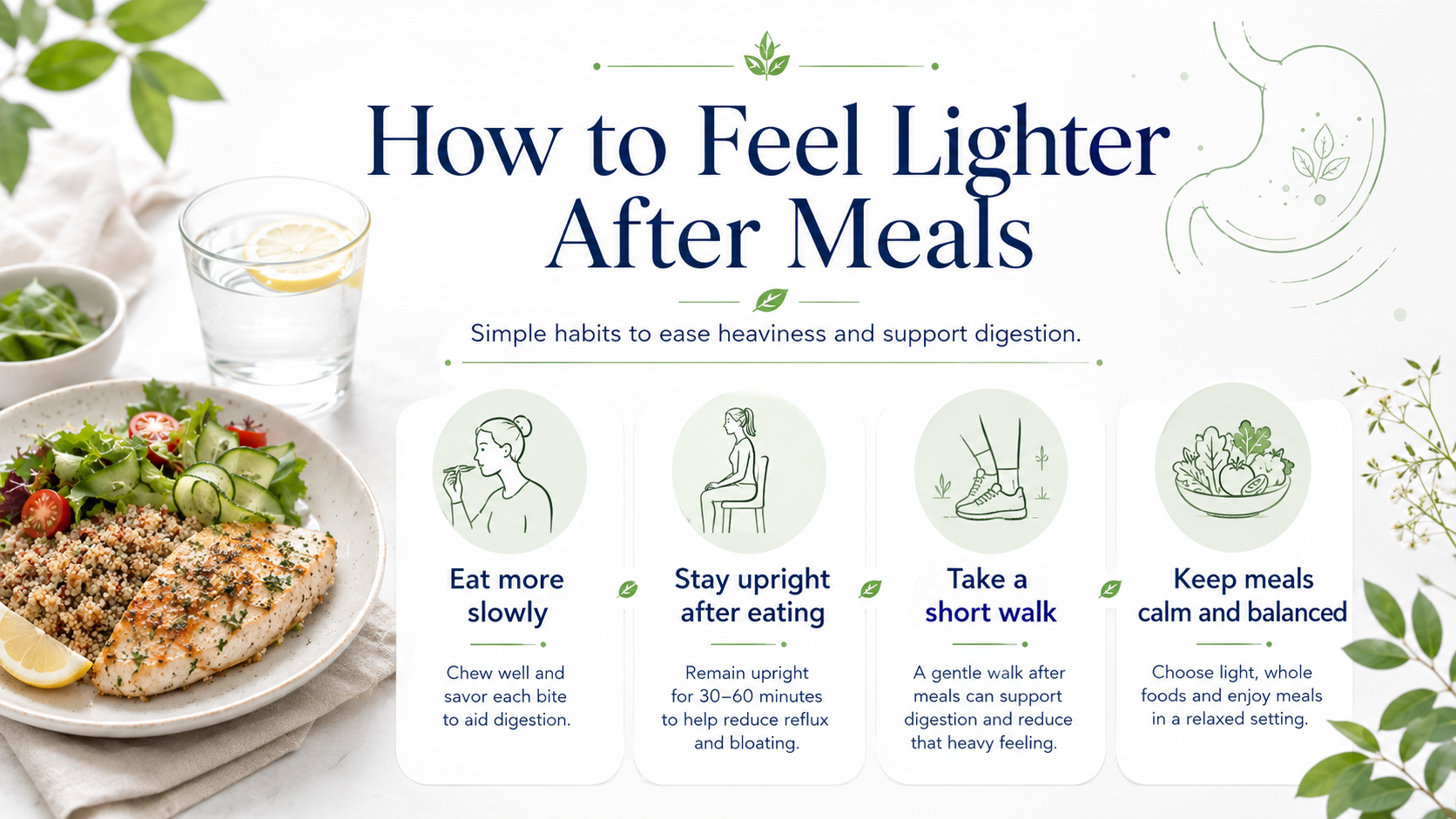
Slow down at the table. This is the single most underrated digestive habit. Research that controlled how quickly people ate found that a slower pace produced greater fullness afterwards, with the slow-eating group later consuming around “25% less energy from snacks” than the fast group. [3] Chewing thoroughly and putting the cutlery down between bites eases the load on the stomach from the start.
Watch the fat load of smaller meals. If a light meal still feels heavy, look at its composition rather than its size. Balancing rich elements with leaner protein, vegetables, and wholegrains can help a meal clear more comfortably.
Take a short, gentle walk. A 10 to 15 minute stroll after eating supports the natural movement of the digestive tract. It does not need to be vigorous — gentle is the point.
Stay upright after meals. Give yourself a couple of hours before reclining. If you eat in the evening, try to do so earlier rather than close to bedtime.
Keep mealtimes calm. Eating away from your desk and your screen, even for ten minutes, lets the body settle into the state in which digestion works best.
Try smaller, more frequent meals. If large meals reliably feel heavy, spreading the same food across the day asks less of the stomach at any one time.
If a heavy feeling follows meals regularly and across a range of different foods, the issue may be less about any single meal and more about overall digestive capacity. This is where some people choose to explore digestive enzyme support. A broad-spectrum digestive enzyme supplement — one covering proteins, fats, carbohydrates, plant fibre, and dairy — can support the more complete breakdown of food while it is still in the upper digestive tract. Digestive Aid from Care & Cure Nutraceuticals contains a 12-strain enzyme blend alongside Betaine HCl, included to support healthy stomach acid levels, and Pepsin for stomach-level protein digestion. Taken at the start of a meal, it works alongside the body’s own digestive processes to support the breakdown of the foods that most commonly sit heavily. Those who prefer a vegetarian formula may wish to compare it with Enzaid.
Summary: Slowing down at meals, watching the fat load of smaller meals, a short walk afterwards, staying upright, and calmer mealtimes are the most practical starting points. Where heaviness is frequent and food-wide, broad-spectrum digestive enzyme support is one option among several.
Why do meals feel heavier as you get older?
It is worth understanding that digestive capacity is not fixed throughout life.
Gastric emptying tends to slow modestly with age, so meals naturally clear the stomach a little less briskly than they once did. At the same time, the production of digestive enzymes can decline. A 2018 systematic review of the ageing pancreas concluded that pancreatic enzyme function is reduced “in healthy older individuals without any gastrointestinal disease” — in other words, as part of normal ageing rather than as a sign of illness. [4] Stomach acid output can also become more modest with age, which slows the very first stage of protein digestion.
None of this is a disease. It is a gradual physiological shift, and it is frequently underappreciated as a reason that meals begin to feel different.
It also explains a common experience: a meal that caused no trouble at 25 can start to feel consistently heavy by the mid-40s, even though nothing about the meal has changed. What has changed is the pace and capacity of the system processing it.
For adults who notice heaviness across many different meals — rich or plain, large or small — this broader pattern often points to overall digestive capacity rather than sensitivity to any single food. It is also why some people choose to make digestive support an ongoing part of their routine rather than an occasional one. If you are considering a digestive enzyme supplement, it is sensible to speak with a healthcare professional first to confirm it is appropriate for your individual circumstances.
Summary: Gastric emptying slows and digestive enzyme output declines gradually with age — a normal physiological shift, not a disease. It helps explain why meals can start to feel heavier from the mid-40s onwards, even when nothing about the meal has changed.
The bottom line
A light meal that still feels heavy is not a contradiction, and it is not something you simply have to accept.
In most cases it traces back to pacing — how quickly the stomach is able to process and release a meal. Fat content, eating speed, stress, timing, and the body’s own digestive capacity all play a part. Understanding that makes the way forward clearer: the goal is to help a meal move through the system smoothly, rather than to keep shrinking the plate.
Eating habits, mealtime pace, and digestive capacity all contribute. Addressing even one of them thoughtfully can make a noticeable difference. Addressing several usually makes a meaningful one.
Frequently asked questions
Why do I feel heavy after eating only a small meal? Heaviness reflects how slowly a meal is processed, not just its size. A small meal that is high in fat, eaten quickly, or eaten under stress can sit in the stomach longer than a larger, leaner meal — which feels like heaviness.
Why do I feel sluggish and tired after eating? A degree of post-meal tiredness is normal, as blood flow and energy are directed toward digestion. Larger or richer meals tend to produce it more. Persistent, pronounced tiredness after most meals is worth discussing with your GP.
How can I stop feeling heavy after meals? Start with pace and composition: eat more slowly, chew thoroughly, balance rich foods with leaner ones, stay upright afterwards, and take a short walk. Where heaviness is frequent and food-wide, some people also explore digestive enzyme support.
Is feeling heavy after eating the same as bloating? Not quite. Heaviness is a sense of fullness and slow digestion, usually higher in the abdomen. Bloating is visible distension and pressure, often lower down, driven by gas. They are different sensations but frequently share the same underlying cause — for more, see our guide to post-meal bloating.
When should I see a doctor about feeling full or heavy after eating? See a GP if you regularly feel full after only a few bites, if heaviness comes with unexplained weight loss, persistent pain, difficulty swallowing, vomiting, or fatigue, or if it does not settle over several weeks. Seek urgent care for severe pain or blood in vomit or stools.
This article is for informational purposes only and does not constitute medical advice. Always consult a qualified healthcare professional before starting any new supplement, particularly if you are pregnant, breastfeeding, taking medication, or have a diagnosed medical condition. Food supplements are not intended to diagnose, treat, cure, or prevent any disease.
References
1. National Health Service (UK). Bloating. NHS. nhs.uk/conditions/bloating
2. National Health Service (UK). Indigestion. NHS. nhs.uk/conditions/indigestion
3. Hawton K, Ferriday D, Rogers PJ, et al. (2019). Slow Down: Behavioural and Physiological Effects of Reducing Eating Rate. Nutrients. PMC6357517
4. Löhr JM, Panic N, Vujasinovic M, Verbeke CS (2018). The Ageing Pancreas: A Systematic Review of the Evidence and Analysis of the Consequences. Journal of Internal Medicine. doi:10.1111/joim.12745
