

What Is Digestive Comfort and How Do People Support It? — A UK Guide for Everyday Gut Wellness
 By Dr. Wali
A good day, digestively, is one you barely notice.
Meals settle. The morning is unremarkable. There is no fullness that lingers an hour too long, no mild gas in the afternoon, no slight tightness across the waistband by evening. You simply get on with the day.
That quiet, unremarkable feeling is what people mean by “digestive comfort”. It is not the absence of every symptom — almost no one has that, and chasing it is a fast route to anxiety about food. It is, more usefully, the everyday baseline where the digestive system is doing its job without drawing attention to itself.
This article explains what digestive comfort actually is, why so many otherwise-healthy UK adults find it slips with age, the habits that influence it most, and when discomfort stops being routine and becomes something to take to a GP.
What is digestive comfort, in plain English?
Digestive comfort is the everyday state in which food moves through the digestive tract smoothly and without producing noticeable symptoms.
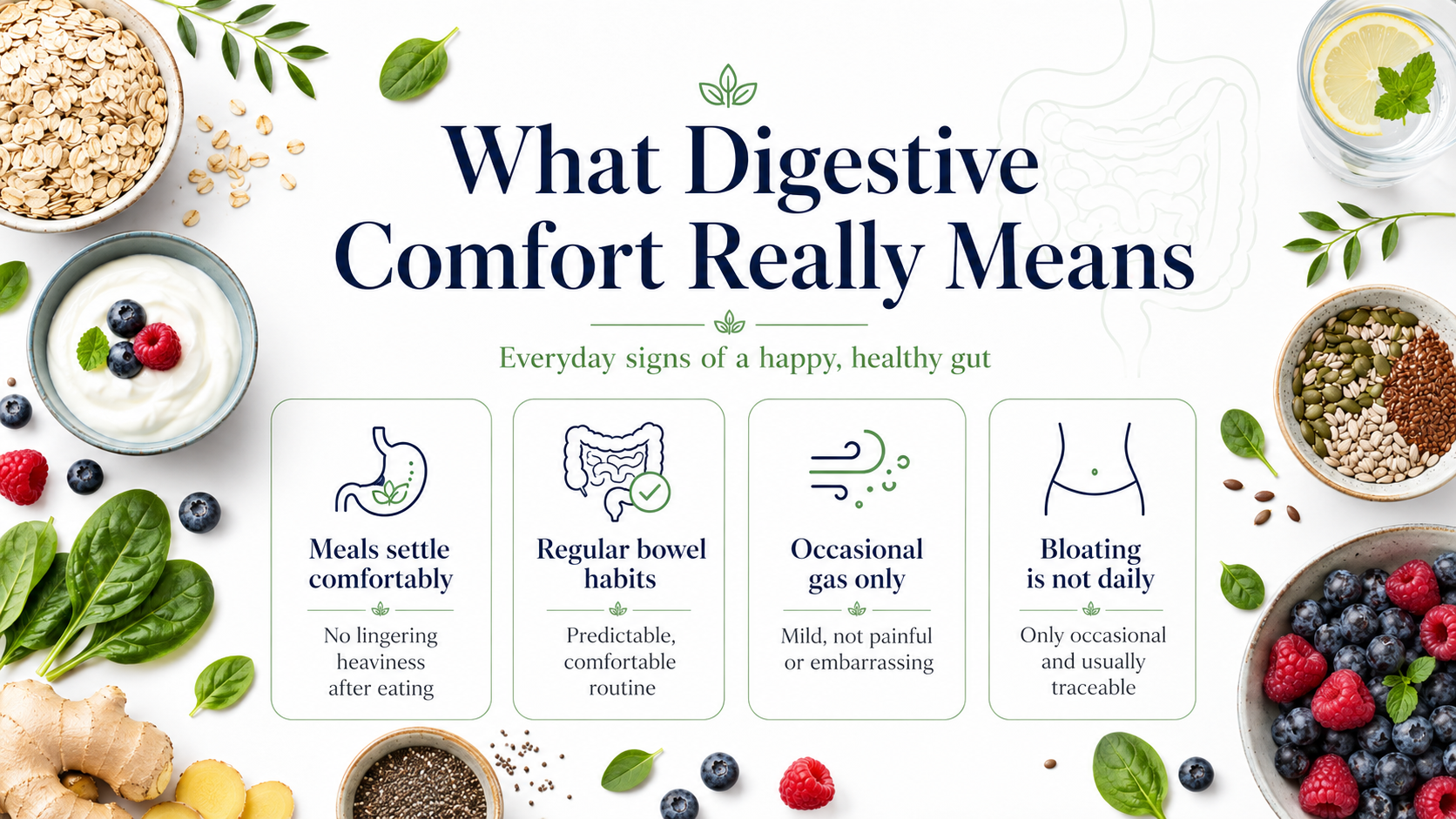
A few practical markers describe it well. Meals settle within a reasonable time and do not leave you feeling weighed down. Bowel habits are reasonably regular and reasonably predictable — your own normal, not someone else’s. Mild gas happens, because it always does, but it is not painful and not embarrassing. Bloating, if it occurs at all, is occasional and obviously linked to a particular meal rather than a daily fixture.
It is worth saying clearly: digestive comfort is not the same as being entirely symptom-free. Even people with cast-iron digestion have the occasional uncomfortable afternoon. The goal is a comfortable baseline most of the time, with occasional bumps you can usually trace to a specific cause — a richer-than-usual meal, a stressful week, a stretch of poor sleep, a late dinner.
The reason this matters is that a great deal of UK supplement marketing is built around the implication that any discomfort is abnormal. It isn’t. The honest target is comfortable digestion most days, not perfect digestion every day.
Summary: Digestive comfort is the everyday baseline at which food moves through the digestive tract without drawing attention to itself. It is not the absence of all symptoms — it is the absence of persistent, daily, disruptive ones. Occasional discomfort, traceable to a specific cause, is normal.
What the digestive system is actually doing across a day
The digestive tract is one of the longest and most active systems in the body — and most of what it does is invisible.
Each meal is mechanically broken down in the mouth and stomach, mixed with acid and enzymes, and released gradually into the small intestine. There, pancreatic enzymes complete the work and most nutrients are absorbed. What remains — mostly fibre, water, and a small amount of other material — passes into the large intestine, where the gut microbiome ferments fibres into useful short-chain fatty acids and the body reclaims water before the stool is formed. The whole process, from plate to bowel, takes most adults somewhere between a day and three days.
A great deal can vary along that path. The pace of gastric emptying changes with meal size and fat content. Enzyme output can vary with age, stress, and overall digestive capacity. The composition of the gut microbiome shifts with what you eat over weeks and months. The rate at which food moves through the large intestine — gut transit time — depends heavily on fibre and fluid intake and on how much you move.
Two further points are worth flagging. The first is that the gut and the brain are in constant two-way communication along what is now called the gut-brain axis. Stress, anxiety, and poor sleep genuinely change how the digestive system behaves — this is not in your head, even when it feels like it might be. The second is that the digestive system has its own nervous system, often called the “second brain”, which controls most of its functions automatically and without conscious input.
Summary: Digestion is a multi-stage process spanning a day or more, involving mechanical breakdown, enzyme action, nutrient absorption, microbial fermentation, and waste formation. Stress, sleep, and the gut-brain axis influence it directly. Most of it is invisible — which is precisely why digestive comfort, when you have it, is something you barely notice.
The factors that most influence digestive comfort
A handful of factors do most of the work, and most of them are habits rather than products.
Fibre intake. The single most consistent finding in UK nutrition is that we eat too little fibre. UK government guidance is to aim for 30g of fibre a day, but the British Dietetic Association notes that “the average fibre intake for adults is 18g, 60% of what it should be.” [1] Fibre matters because it bulks the stool, supports regular bowel movement, and feeds the gut microbiome that ferments it. Increasing fibre is the single biggest practical lever for digestive comfort most adults have.
Hydration. Fibre needs water to do its work. Without adequate fluid, increasing fibre tends to produce more discomfort rather than less. The two go together.
Meal pace. Eating quickly delivers larger food particles to the stomach and gives the brain less time to register fullness. Chewing thoroughly and putting the cutlery down between bites does a surprising amount of useful work — see our related article on why lighter meals can still feel heavy for more on this.
Meal composition. Very rich meals, very large meals, and very fatty meals are all slower to digest. Balanced plates — protein, vegetables, wholegrains, healthy fats — are easier to handle than meals that lean heavily on one component.
Stress. The gut-brain axis is well established. A 2025 review in Digestive Diseases notes the long-recognised effects of psychological stress on digestive function, including gastrointestinal motility and the secretion of stomach acid and pancreatic enzymes. [2] Persistent stress, more than any individual food, is one of the most reliable disruptors of digestive comfort.
Sleep. Short or broken sleep affects gut motility and the next day’s appetite signalling. A meal eaten after a bad night often feels heavier than the same meal would have felt after a good one.
Movement. Regular daily activity supports gut transit. People who walk routinely tend to have fewer issues with sluggish digestion than people who don’t, independent of what they eat.
Pace of dietary change. A genuinely useful note: increasing fibre too quickly produces gas, bloating, and discomfort even though the long-term direction is right. Increase gradually over a few weeks, and increase fluid alongside it.
Summary: Fibre intake, hydration, meal pace and composition, stress, sleep, and regular movement are the strongest influences on digestive comfort. None is dramatic alone. Together, they explain most of the variation most adults experience.
When digestive discomfort warrants a conversation with your GP
Most occasional digestive symptoms are entirely normal and resolve on their own. Some patterns, however, are worth taking seriously and bringing to your GP rather than addressing through diet alone.
Make an appointment with your GP if you notice any of the following:
- A persistent change in bowel habit — looser, harder, more frequent, or less frequent than your normal, lasting more than two to three weeks
- Persistent or recurrent abdominal pain
- Bloating that is severe, painful, or constant for more than a few weeks
- Unexplained weight loss
- Persistent nausea or repeated vomiting
- Difficulty or pain when swallowing
- Feeling full very quickly after only a few bites (early satiety) when it happens regularly
- Digestive symptoms that wake you from sleep
- Any new digestive symptoms beginning after the age of 50
- A close family history of bowel cancer, coeliac disease, or inflammatory bowel disease
- Persistent fatigue alongside digestive symptoms
Seek urgent medical care for severe abdominal pain, vomit that contains blood or looks like coffee grounds, stools that are black and tarry, or visible blood in the stool. These can point to problems that need prompt assessment.
For NHS guidance on persistent digestive symptoms, see the NHS pages on bloating, constipation, and indigestion. [3] The NHS also runs the bowel cancer screening programme for adults aged 50 to 74 in England and Wales — a home test kit posted out every two years. If you have received one and not yet used it, it is one of the most evidence-led things you can do for your long-term gut health.
Summary: Occasional digestive symptoms are normal. A persistent change in bowel habit, ongoing pain, unexplained weight loss, blood, difficulty swallowing, night-time symptoms, or any new digestive symptoms after 50 should always be reviewed by a qualified healthcare professional.
How to support digestive comfort day to day
Most of what makes the biggest difference here is unglamorous, free, and consistent — which is true of most of what works in everyday health.
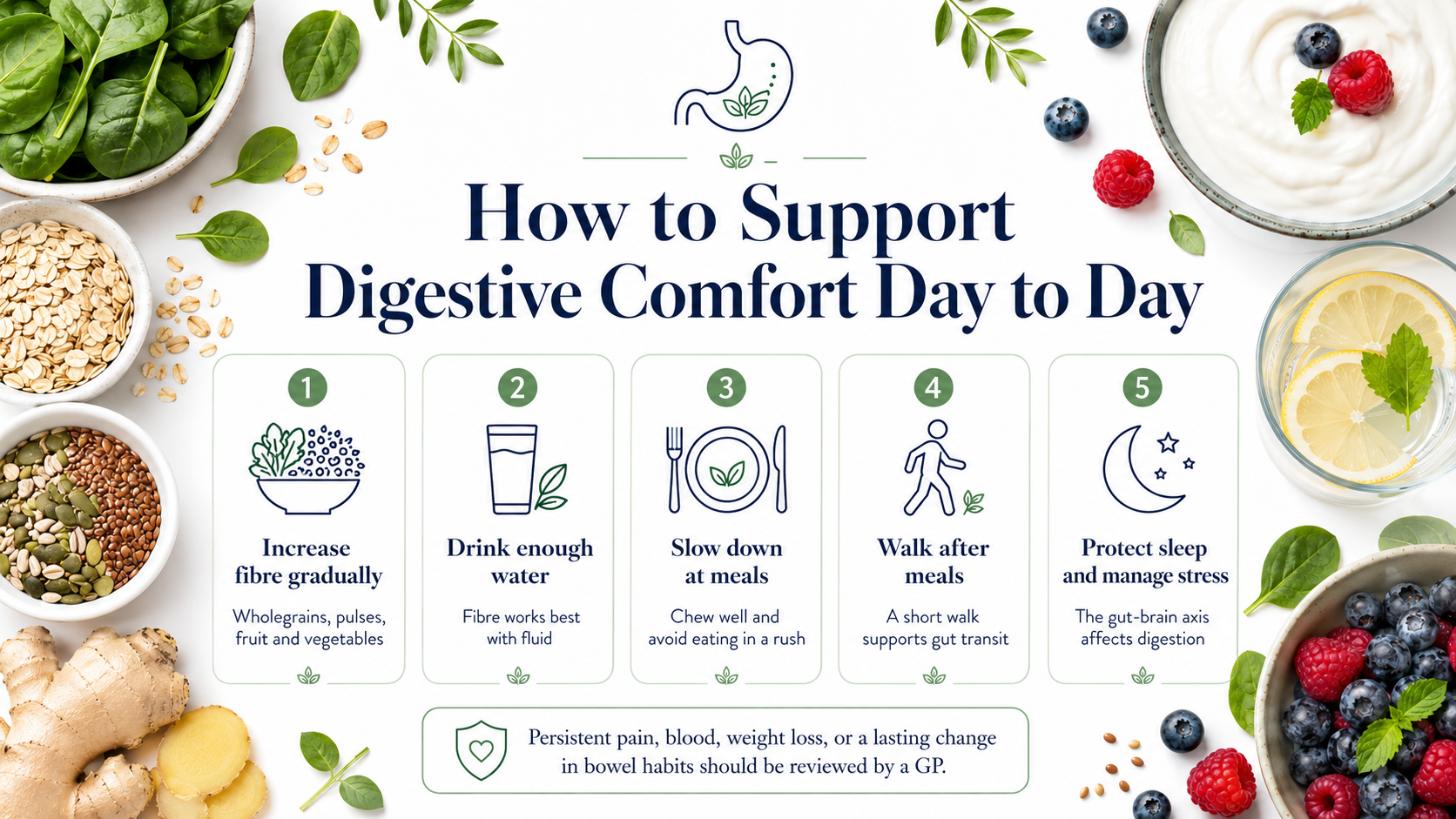
Build meals around fibre, gradually. Wholegrains, pulses, vegetables, fruit, nuts, and seeds are the foundation. The aim is to move toward the UK guideline of 30g of fibre a day, but add fibre in steps over two to three weeks rather than overnight — your gut microbiome needs time to adjust, and a sudden jump produces gas, bloating, and discomfort even when the long-term direction is right. [1]
Drink enough water. Aim for six to eight cups of fluid a day, more if you exercise or the weather is warm. Fibre without fluid doesn’t work properly.
Slow down at the table. Chew thoroughly, put your cutlery down between bites, and try not to eat at your desk or on the move where possible. This is one of the most underrated digestive habits.
Walk after meals. Even ten to fifteen minutes makes a noticeable difference. Movement supports the normal forward movement of food through the digestive tract.
Protect your sleep. A regular bedtime and a calm wind-down do useful digestive work that no supplement can replicate.
Notice the stress connection — and act on it. Time outdoors, social contact, and a few minutes of intentional calm at the start and end of the day all matter. Long-running stress is one of the most reliable disruptors of digestive comfort. [2]
Be cautious about elimination diets without guidance. Cutting out whole food groups is sometimes useful under the supervision of a registered dietitian, but doing so unilaterally tends to narrow the diet, reduce fibre, and create new digestive problems. If you suspect a specific intolerance, ask your GP for a referral rather than diagnosing yourself.
If digestion feels consistently harder than it used to — across different meals, not just specific ones — overall digestive capacity may be part of the picture. This is where some adults explore digestive enzyme support. A broad-spectrum digestive enzyme supplement is formulated to support the normal breakdown of food across multiple food groups while it is still in the upper digestive tract.
Digestive Aid from Care & Cure Nutraceuticals contains a 12-strain proprietary enzyme blend (proteases, amylases, lipase, cellulase, lactase, and others) alongside Betaine HCl, Pepsin, Bromelain, and a fungal lactase addition. The formula is designed to support the normal breakdown of proteins, fats, carbohydrates, fibre, and dairy as part of everyday digestion — covering the full spectrum of food types rather than a single category. Taken at the start of a meal, it works alongside the body’s own digestive processes rather than replacing them. Adults who prefer a vegetarian formula may wish to compare it with Enzaid. Consult a healthcare professional before use if you are pregnant, breastfeeding, taking any medication, or have a history of gastric or duodenal ulcers.
Summary: A gradual increase in fibre with adequate fluid, slower mealtimes, post-meal walks, decent sleep, and addressing the stress connection are the most effective ways to support digestive comfort. Broad-spectrum digestive enzyme support is one option for adults who find overall digestive capacity less reliable than it used to be — used alongside, not in place of, those habits.
Why digestive comfort changes as we get older
It is worth understanding why digestive comfort tends to feel a little harder to maintain from the mid-40s onwards.
Gastric emptying — the speed at which the stomach hands food on to the small intestine — slows modestly with age. Digestive enzyme output, including pancreatic enzymes and stomach acid, can also become more modest. The gut microbiome shifts in composition over decades, often becoming less diverse unless actively supported by a varied, fibre-rich diet. And gut transit through the large intestine tends to slow, which is part of why occasional constipation becomes more common.
None of this is a disease. It is a normal physiological drift — but it is a useful explanation for why a meal that caused no trouble at 25 can start to feel different by the mid-40s and 50s. What has changed is the system processing it, not the meal.
Two practical implications follow. The first is that the lifestyle foundations — fibre, fluids, pace, movement, sleep, stress — matter more with age, not less. They are doing useful work even when nothing feels obviously wrong. The second is that for adults whose overall digestive capacity feels less reliable than it used to be, broad-spectrum digestive enzyme support becomes one reasonable option to explore alongside those habits, ideally in conversation with a healthcare professional.
Summary: Gastric emptying slows, enzyme output declines, the gut microbiome shifts, and transit slows gradually with age — a normal physiological drift, not a disease. The lifestyle foundations matter even more in this decade, and digestive enzyme support is one option for adults whose overall digestive capacity feels less reliable than it used to be.
The bottom line
Digestive comfort is one of the more useful concepts in everyday health — and one of the more misunderstood.
It is not the absence of every symptom. It is the everyday baseline at which the digestive system does its job without drawing attention to itself. Occasional discomfort, traceable to a specific cause, is part of being human and not a sign of anything wrong.
The most reliable levers are familiar. Adequate fibre, increased gradually. Enough water to let it work. Slower mealtimes. Movement after meals. Decent sleep. Honest attention to the stress connection. Most of this is free, none of it is dramatic, and applied consistently, it does most of the work.
Persistent or unusual symptoms — a sustained change in bowel habit, ongoing pain, unexplained weight loss, blood, or any new digestive symptom after the age of 50 — are always a conversation to have with your GP rather than your supplement shelf.
Frequently asked questions
What does “digestive comfort” actually mean? Digestive comfort is the everyday baseline at which food moves through the digestive system without producing noticeable symptoms — meals settle, bowel habits are reasonably regular, and any mild gas or bloating is occasional rather than daily. It is not the absence of all symptoms.
How can I improve my digestive comfort naturally? The most evidence-led changes are gradually increasing fibre toward the UK target of 30g a day, drinking enough water, eating more slowly, walking after meals, protecting your sleep, and addressing chronic stress. Most adults notice improvement within a few weeks of consistent changes.
How much fibre should UK adults eat for healthy digestion? UK government guidance is 30g of fibre a day for adults. The average UK adult intake is around 18g — well below the recommendation. Increase fibre gradually over two to three weeks with adequate fluid to avoid bloating and gas while your gut adjusts.
Why does my digestion feel worse after 40? Gastric emptying slows modestly with age, digestive enzyme output can decline, the gut microbiome becomes less diverse, and gut transit slows — all part of normal physiological ageing rather than disease. The same lifestyle foundations matter even more in this decade.
When should I see a doctor about digestive discomfort? See your GP if you have a persistent change in bowel habit, ongoing pain, unexplained weight loss, difficulty swallowing, persistent vomiting, blood in the stool, night-time symptoms, or any new digestive symptoms beginning after the age of 50. Severe pain or visible blood needs urgent medical assessment.
This article is for informational purposes only and does not constitute medical advice. Always consult a qualified healthcare professional before starting any new supplement, particularly if you are pregnant, breastfeeding, taking medication, or have a diagnosed medical condition. Food supplements are not intended to diagnose, treat, cure, or prevent any disease.
References
1. British Dietetic Association. Fibre — Food Fact Sheet. BDA. bda.uk.com/resource/fibre
2. Holtmann G, Talley NJ (2025). Decoding the Gut-Brain Axis: A Journey toward Targeted Interventions for Disorders-of-Gut-Brain Interaction. Digestive Diseases. 43(3):257–268. doi:10.1159/000543589
3. National Health Service (UK). Bloating, Constipation, Indigestion — patient guidance. NHS. nhs.uk/conditions/bloating · nhs.uk/conditions/constipation · nhs.uk/conditions/indigestion
4. NHS England. Bowel cancer screening. NHS. nhs.uk/conditions/bowel-cancer-screening
