
Chromium Niacinate vs Chromium Picolinate Why the Food Form Wins (2026 Guide)
 By Dr. Wali
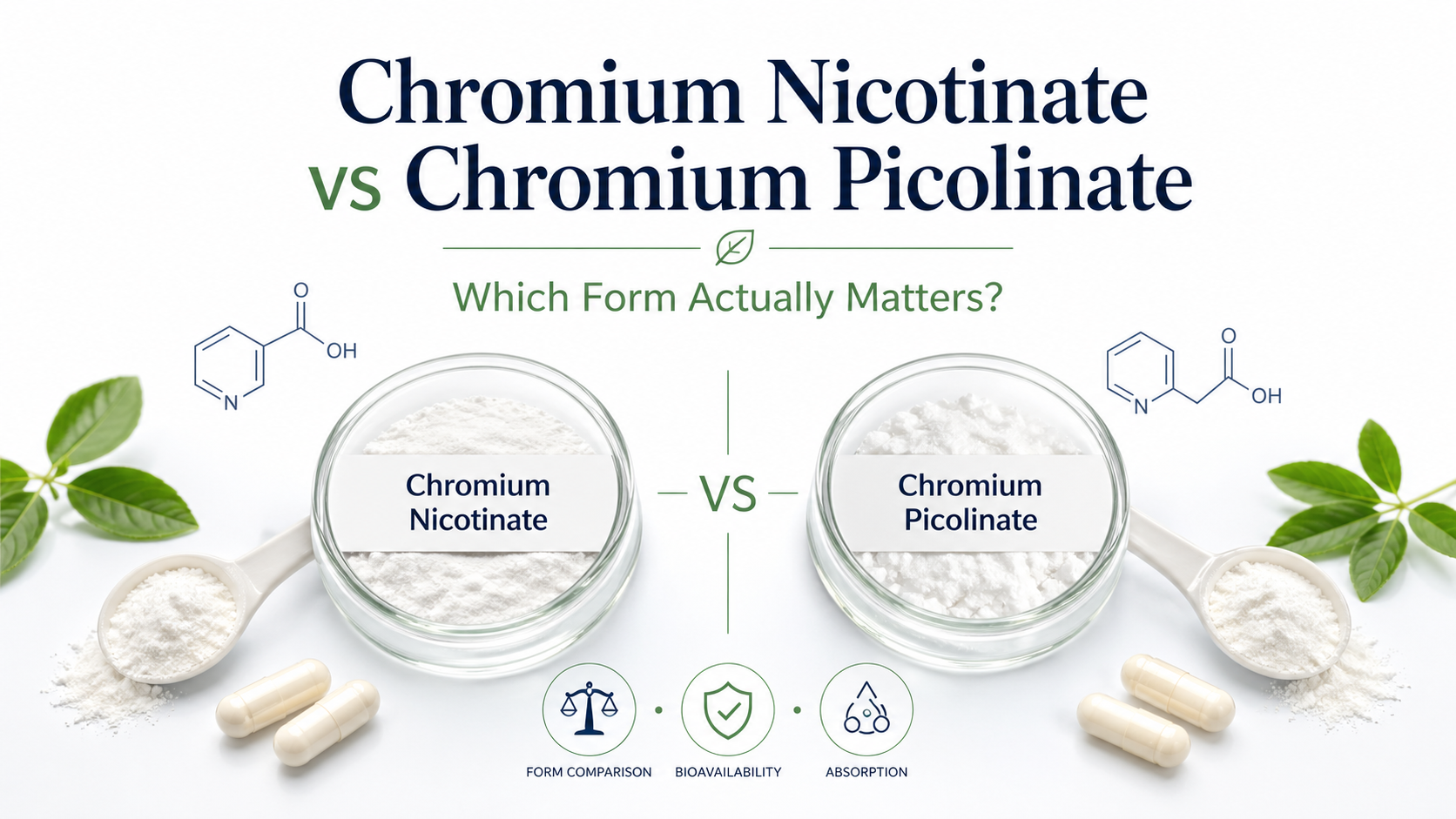
Here is a question worth asking when you pick up a chromium supplement. Where does chromium actually come from in food, and which supplement form most closely mirrors that? The answer to that question points clearly toward chromium niacinate. And yet most of the clinical literature uses picolinate. That apparent contradiction is worth understanding before you decide.
This article makes the case for chromium niacinate. Not because the clinical trial count favours it. It does not. But because the biochemical argument, the safety profile, and the food-form principle all do. And when it comes to trace mineral supplementation, those things matter quite a lot.
More Studies Does Not Mean Better
Chromium picolinate has a larger clinical trial base than chromium niacinate. That is simply true. Picolinate became the dominant research form in the 1990s partly because it was patented and commercially promoted, which funded studies. This is not an unusual situation in nutritional science. The most researched form of an ingredient is not always the most natural, the safest, or the best aligned with how the body actually handles the mineral.
Consider Vitamin E. The most-studied synthetic form is dl-alpha-tocopherol. But the natural food form is d-alpha-tocopherol, and research has consistently shown better retention and biological activity for the natural form at equivalent doses [1]. Volume of research does not settle the question of which form is more biologically appropriate.
The same principle applies here. Picolinate was researched extensively. Niacinate was not, partly because it was not aggressively patented and promoted in the same way. But the underlying biochemistry tells a different story about which form more closely resembles chromium as it exists in nature.
The Form Chromium Takes in Food
When Mertz and Schwarz first identified chromium as a nutritionally essential element in the 1950s, they were working with something they called glucose tolerance factor [2]. It was a compound found in brewer’s yeast that restored normal glucose metabolism in chromium-deficient rats. It worked in a way that inorganic chromium salts alone did not.
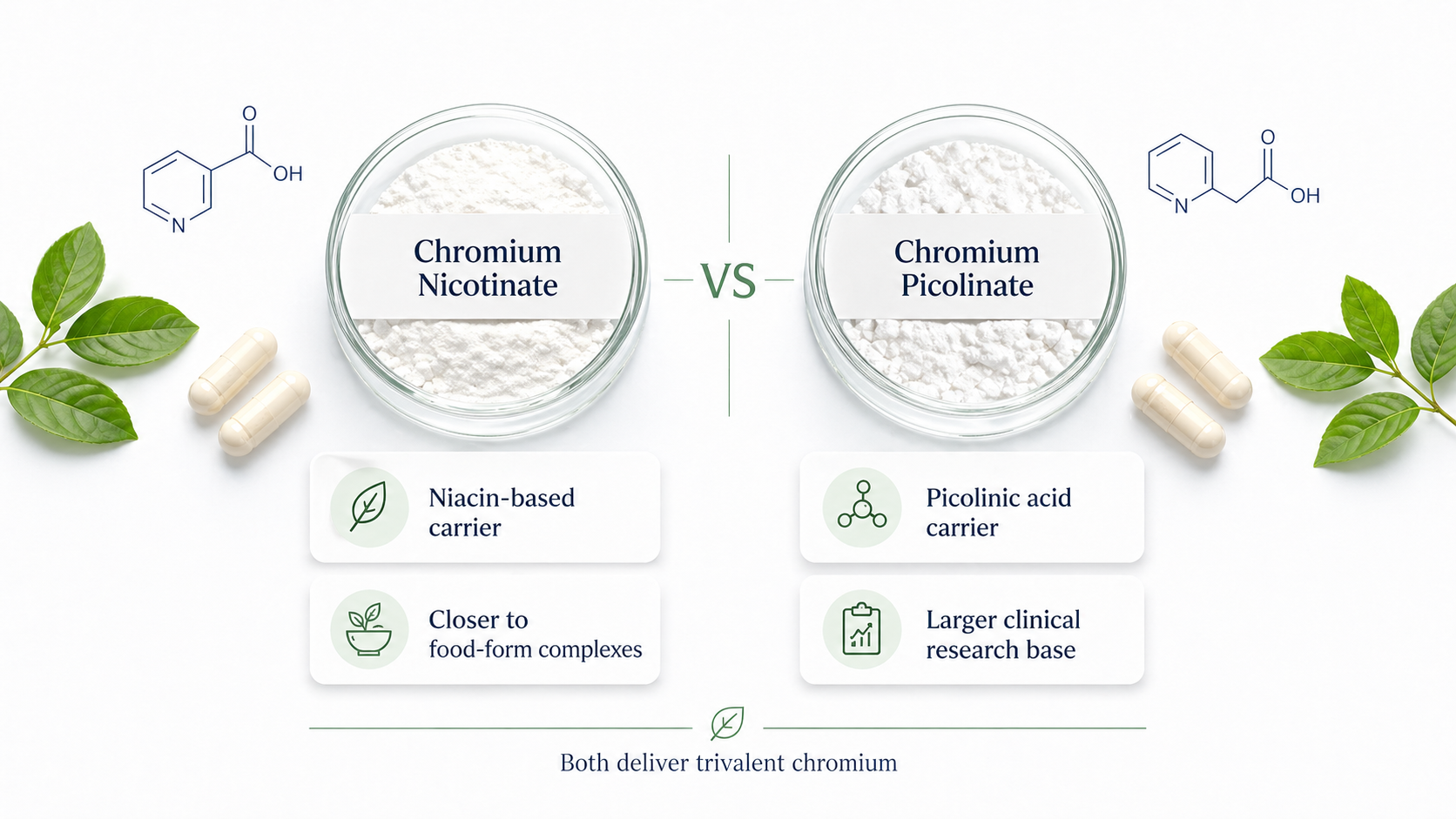
Later research established that glucose tolerance factor is a small chromium-containing molecule in which chromium is bound to nicotinic acid alongside several amino acids [3]. The carrier molecule at the heart of naturally occurring food-form chromium is nicotinic acid. The same compound used to make chromium niacinate and chromium nicotinate.
Chromium niacinate is not just one option among several supplement forms. It is the form that most closely mirrors how chromium exists in the human body and in food. Picolinate does not have that claim.
Vincent’s foundational work on low-molecular-weight chromium-binding substance, published across multiple papers including a 2000 review in the Journal of Nutrition [3], showed that the biological chromium complex uses nicotinic acid as a structural component. When you eat a plate of broccoli or a portion of beef, the chromium your body absorbs is not picolinate-bound. It is naturally occurring and niacinate-adjacent.
For someone who cares about supplement forms that mirror food biochemistry rather than synthetic chelation chemistry, that matters significantly.
What Picolinate Actually Is and Why Some Researchers Have Raised Questions
Picolinic acid, the carrier molecule in chromium picolinate, is a metabolite of tryptophan. It does not occur naturally as a chromium carrier in the body. It was selected for use as a chromium carrier in supplements because it is a powerful chelating agent, meaning it grips the chromium tightly and creates a stable, absorbable complex.
That tight grip creates a good absorption story. But it has also prompted scientific scrutiny. Vincent, reviewing the potential and toxicity of chromium picolinate, noted that picolinate is a strong ligand that can cross cell membranes and may interact with DNA under certain conditions [4]. Stearns and colleagues published research demonstrating that chromium picolinate promoted oxidative damage in cell culture studies, a finding that generated considerable scientific debate [5].
To be clear, the concerns about picolinate are largely theoretical at normal supplement doses. The EFSA safety assessment in 2010 did not identify a safety concern at typical supplemental levels. But the concern exists in the peer-reviewed literature, and it is worth knowing about.
Chromium niacinate does not carry these theoretical concerns. Nicotinic acid is Vitamin B3. It is a nutrient the body produces naturally, uses constantly, and excretes efficiently. The chromium niacinate complex does not have the same chelation behaviour as picolinate. It is gentler by design, which is precisely why it more closely resembles the food form.
The Absorption Question
You will sometimes read that picolinate absorbs better than niacinate. This claim is based on the tight binding properties of picolinic acid, which do appear to improve chromium uptake in some studies. The argument is that a more tightly bound chromium complex resists breakdown in the digestive tract better and therefore delivers more chromium to the bloodstream.
What that argument misses is context. The body has evolved mechanisms for absorbing the chromium it encounters in food. Those mechanisms are calibrated for the food form of chromium, not for a synthetic picolinate chelate. A 2010 review of chromium bioavailability by Anderson [6] noted that chromium absorption varies substantially depending on chromium status, dietary factors, and the form consumed, and that the practical differences between forms at normal supplemental doses are difficult to establish definitively in free-living human populations.
The niacinate form, because it mirrors the structure of food-form chromium, works with the body’s existing chromium absorption pathways rather than bypassing them with a synthetic carrier. That is not a weakness. It is an argument for physiological compatibility.
A Note on Chromium Polynicotinate
Chromium polynicotinate, sometimes sold as GTF Chromium, is a patented form in which chromium is bound to multiple nicotinic acid molecules alongside amino acids. It is a more complex version of the same niacinate principle, designed to more closely replicate the full GTF chromium structure found in food.
Some manufacturers use niacinate. Others use polynicotinate. Both are forms of chromium carried by nicotinic acid. Both more closely reflect the natural food form than picolinate does. The difference between them is primarily one of structural complexity and patent status rather than a fundamental difference in quality.
Chromium niacinate and chromium polynicotinate share the same fundamental advantage over picolinate. Their carrier molecule is a natural vitamin rather than a synthetic chelate. That is the important distinction.
Diacare metabolic support supplement
What This Means for a Balanced Diet
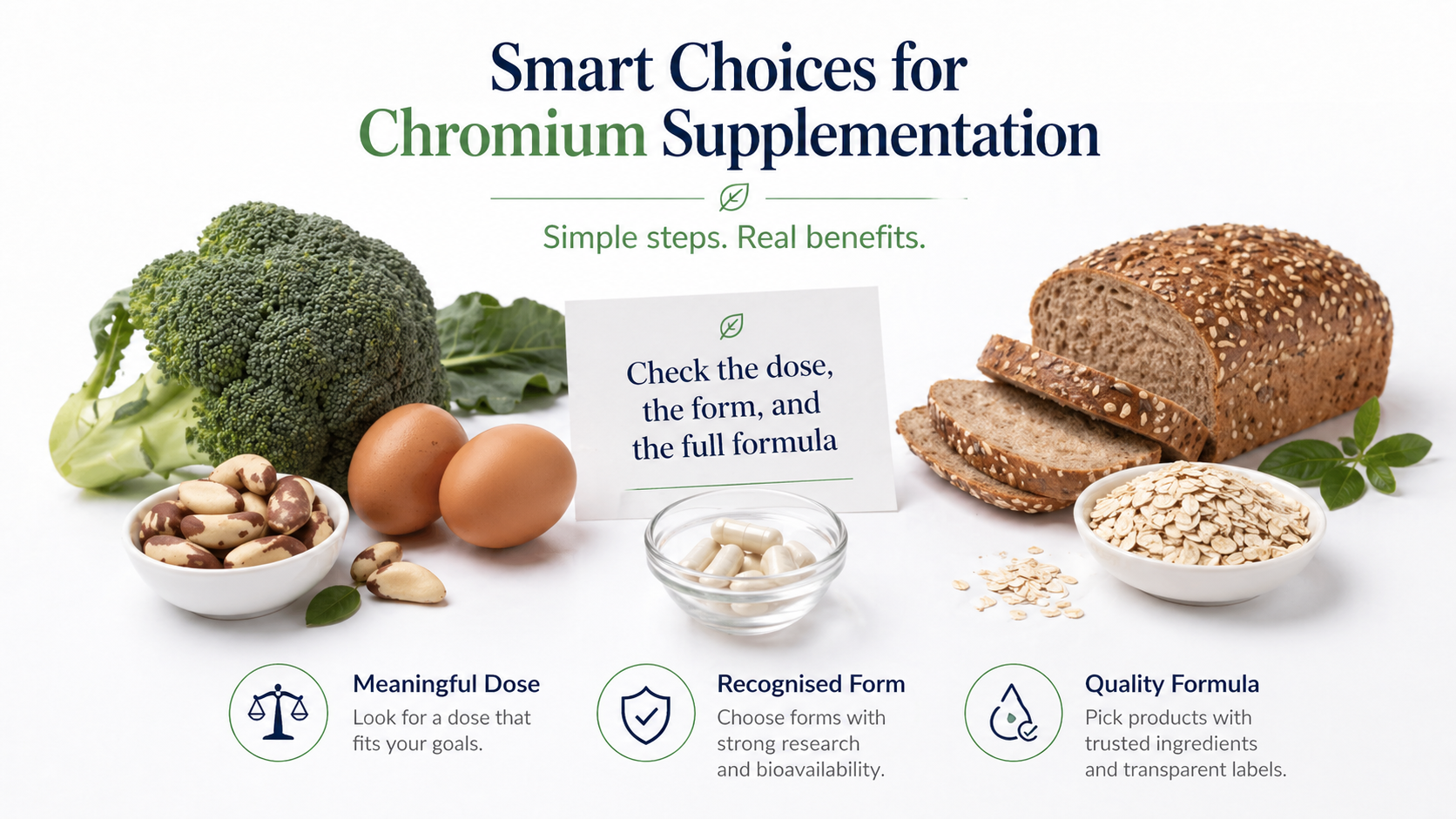
Chromium is found in broccoli, beef, egg yolk, wholegrains, and Brazil nuts. The British Dietetic Association notes that for most people eating reasonably varied diets, chromium intake from food is adequate. White bread provides far less chromium than wholemeal, because processing removes trace mineral content.
For the population who might consider supplementation, the case for choosing a form that mirrors dietary chromium is strengthened by the food-form principle. If you are topping up a nutrient that you normally get from food, using the form that most closely resembles the food source is a reasonable principle to follow. It is the same logic that drives preference for natural Vitamin E over synthetic, or methylfolate over folic acid.
Chromium niacinate is that form for chromium.
Reading a Supplement Label What to Actually Look For
Imagine you are someone who has recently had a health check. Your GP has mentioned your blood sugar is in the upper end of the normal range, you have been advised to look at diet and lifestyle, and you are considering whether a chromium supplement makes sense as part of a broader nutritional approach.
You find two products on a shelf. One lists chromium picolinate. One lists chromium niacinate or chromium polynicotinate. You now have a reason to prefer the second. Not because the first is dangerous or useless. But because the second more closely mirrors the form your body would encounter if you were getting your chromium from food.
- Check that the chromium dose is meaningful. The UK Nutrient Reference Value is 40 micrograms per day. A supplement should meet or exceed that.
- Look for GMP certification. Manufacturing standards matter more than form differences at normal doses.
- Consider the broader formula. Chromium alongside Magnesium, which also carries the authorised claim for normal blood glucose levels, provides more complete metabolic mineral support than chromium alone.
The authorised health claim for chromium in the UK, confirmed by EFSA, is that chromium contributes to the maintenance of normal blood glucose levels and to normal macronutrient metabolism. Both forms carry that claim. The form you choose determines how the chromium gets there.
Why Diacare Uses Chromium Niacinate
When formulating Diacare, Care and Cure chose chromium niacinate rather than chromium picolinate. The reasoning follows directly from the science outlined above. Diacare is built around ingredients that support normal carbohydrate and glucose metabolism in forms the body recognises and works with efficiently.
Chromium niacinate sits alongside Berberine HCl, Alpha Lipoic Acid, Vanadyl Sulfate, Taurine, N-Acetyl L-Cysteine, and Magnesium in the Diacare formula. Each ingredient was selected for its research background and its structural or biochemical compatibility with normal metabolic function. Using a synthetic picolinate carrier when a food-form niacinate alternative exists was a straightforward decision.
Diacare metabolic support supplement
It is worth being direct about this. Chromium niacinate has fewer clinical trials than chromium picolinate. If you are evaluating a supplement purely on the number of published studies for the specific compound, picolinate wins that comparison. But if you are asking which form is more physiologically aligned, which has the stronger safety profile at the molecular level, and which more closely mirrors what your body encounters when chromium comes from food, niacinate answers all three questions favourably.
That is why it is in Diacare. And it is a reasonable basis for preferring it when you read a supplement label.
Frequently Asked Questions
Is chromium niacinate better than chromium picolinate?
For most purposes, yes. Chromium niacinate more closely mirrors the form chromium takes in food and in the body’s own chromium-binding molecules. Picolinate has a larger volume of clinical research, largely because it was aggressively commercialised, but a larger research base does not automatically mean a better or more natural ingredient. Niacinate uses nicotinic acid, which is Vitamin B3, as its carrier. Picolinate uses a synthetic chelating agent. For people who prioritise food-form supplementation, niacinate is the better choice.
What is the difference between chromium niacinate and chromium nicotinate?
They are the same compound described under two different naming conventions. Nicotinic acid and niacin are both names for Vitamin B3. A chromium compound bound to nicotinic acid can legitimately be called either chromium niacinate or chromium nicotinate. If you see both names on different product labels, they refer to the same type of ingredient.
Why does chromium picolinate have more studies than chromium niacinate?
Chromium picolinate was patented in the 1980s and commercially promoted heavily through the 1990s. That commercial backing funded a large volume of research. Chromium niacinate did not receive the same level of commercial investment in clinical trials, which is why the research base is smaller. This reflects funding patterns in nutritional science rather than any meaningful difference in nutritional quality between the two forms.
Are there any concerns about chromium picolinate?
At normal supplement doses, chromium picolinate is considered safe by regulatory bodies including the EFSA. However, some peer-reviewed research has raised theoretical concerns about the behaviour of picolinic acid as a synthetic chelating agent at cellular level. No such theoretical concerns exist for chromium niacinate, whose carrier molecule is a natural vitamin that the body produces and uses routinely. The concerns are theoretical rather than demonstrated at typical supplement doses, but the niacinate safety profile is cleaner.
What is GTF chromium and how does it relate to niacinate?
GTF stands for glucose tolerance factor, the naturally occurring chromium compound first identified in brewer’s yeast by researchers Mertz and Schwarz in the 1950s. Subsequent research established that the GTF structure uses nicotinic acid as a core component, alongside amino acids. Chromium niacinate and chromium polynicotinate are both based on this nicotinic acid principle, which is why GTF chromium is often used as a broader term for niacinate-type forms. This heritage is one of the strongest arguments for niacinate being the more biologically authentic chromium supplement form.
References and Further Reading
1. Traber MG, Atkinson J (2007). Vitamin E, antioxidant and nothing more. Free Radical Biology and Medicine. Vol 43, Issue 1, pp 4-15. PMID 17561088
2. Schwarz K, Mertz W (1959). Chromium III and the glucose tolerance factor. Archives of Biochemistry and Biophysics. Vol 85, Issue 1, pp 292-295. PMID 14444068
3. Vincent JB (2000). The biochemistry of chromium. Journal of Nutrition. Vol 130, Issue 4, pp 715-718. PMID 10736319
4. Vincent JB (2003). The potential value and toxicity of chromium picolinate as a nutritional supplement, weight loss agent and muscle development agent. Sports Medicine. Vol 33, Issue 3, pp 213-230. PMID 12699315
5. Stearns DM, Wise JP Sr, Patierno SR, Wetterhahn KE (1995). Chromium III picolinate produces chromosome damage in Chinese hamster ovary cells. FASEB Journal. Vol 9, Issue 15, pp 1643-1648. PMID 8529846
6. Anderson RA (1998). Chromium, glucose intolerance and diabetes. Journal of the American College of Nutrition. Vol 17, Issue 6, pp 548-555. PMID 9853534
7. EFSA Panel on Food Additives and Nutrient Sources (2010). Scientific opinion on chromium picolinate as a source of chromium added for nutritional purposes. EFSA Journal. Vol 8, Issue 3, p 1535. Available at efsa.europa.eu
8. Mertz W (1993). Chromium in human nutrition a review. Annual Review of Nutrition. Vol 13, pp 23-41. PMID 8369143
